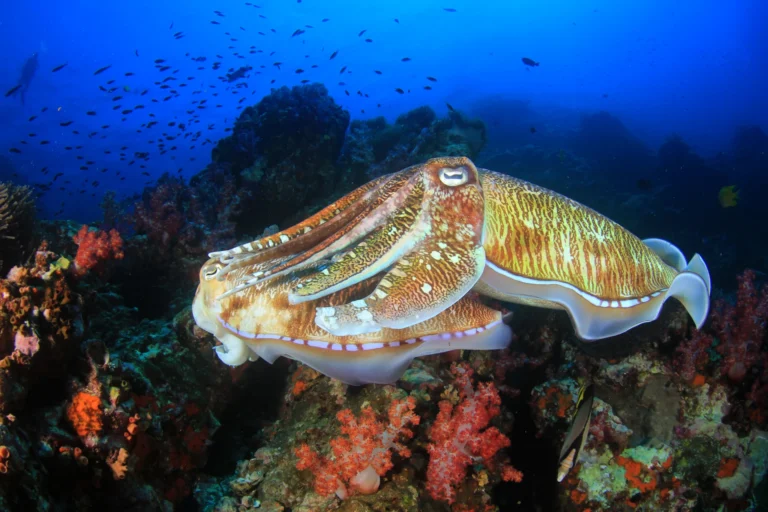
You’re finning slowly along the reef when a patch of coral in front of you… moves. Two arms lift, a wave of color ripples down its body, and suddenly you’re eye to eye with an animal that was completely invisible a second ago. It hangs there in the water, fins rippling along its sides, and studies you right back through a strange W-shaped pupil.
That’s a cuttlefish. And once one has really looked at you, you don’t forget it.
They don’t get the headlines octopuses do, and plenty of divers swim straight past them without realizing what they’re seeing. Big mistake. Cuttlefish are some of the most extraordinary animals on the reef, and Bohol’s waters are a brilliant place to meet them.
Not a Fish, Not an Octopus
First things first: a cuttlefish isn’t a fish at all. It’s a cephalopod, part of the same brainy family as octopus and squid.
Like their cousins, they’ve got eight arms. But cuttlefish also carry two longer feeding tentacles that stay tucked out of sight until it’s time to strike. Inside the body sits the cuttlebone, a gas-filled internal shell they use to fine-tune their buoyancy, hovering in the water with a control that makes most divers jealous.
Their biology reads like science fiction. Three hearts. Blood that runs blue-green instead of red, because it carries oxygen with copper rather than iron. And a nervous system developed enough that, drop for drop, cuttlefish rank with octopus as among the smartest invertebrates in the ocean.
The Best Camouflage in the Sea, From a Colorblind Animal
Here’s the trick that stops divers in their tracks. A cuttlefish can change the color, the pattern, and even the texture of its skin in under a second.
It does this with millions of tiny pigment sacs called chromatophores, layered over cells that reflect and scatter light. Muscles around each sac squeeze and release, firing color across the skin like pixels on a screen. To break up its outline, it pushes up little skin bumps called papillae, turning smooth skin into something that looks exactly like coral or algae.
Now for the part that makes no sense. Cuttlefish are almost certainly colorblind, seeing the world in shades of a single color. Somehow they still pull off camouflage that matches their surroundings perfectly, most likely by sensing light in ways we’re still working out. An animal that can’t see color, doing a flawless impression of the reef it’s sitting on.
The Hypnotist of the Reef
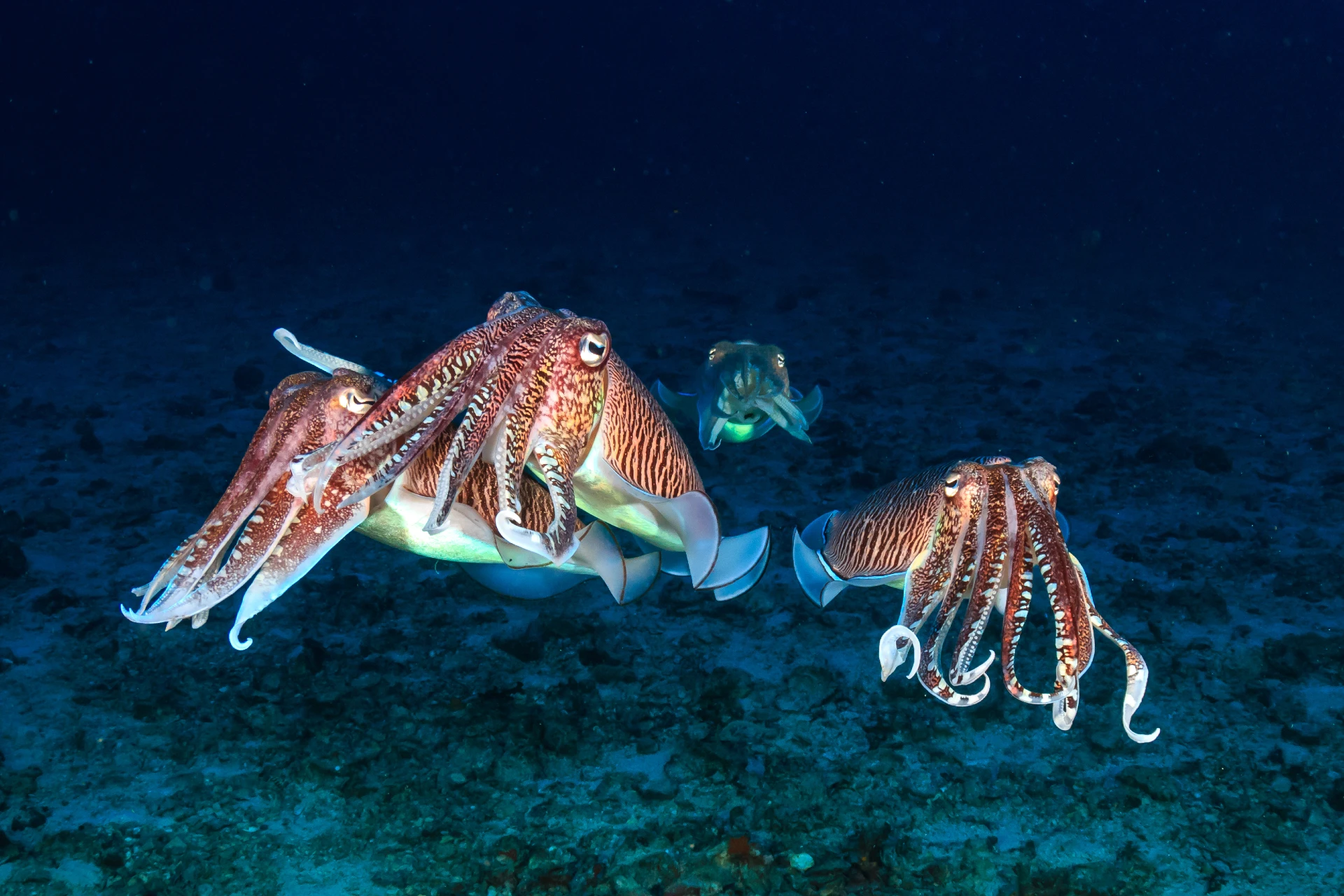
Watch a broadclub cuttlefish hunt and you’ll catch one of the wildest displays on the reef. As it closes in on a crab or shrimp, bands of dark color begin pulsing down its arms, rolling forward again and again like a moving barcode.
Scientists think this “passing cloud” display mesmerizes the prey and freezes it in place. Then, faster than your eye can follow, those two hidden tentacles fire out and snatch it. Dinner, courtesy of hypnosis.
The clever streak runs past hunting, too. Smaller males, too little to win a straight fight over a mate, will disguise half their body as a female to slip past bigger rivals and court a female right under their noses. Reef con artists, basically.
Bohol’s Cuttlefish Cast
Around Panglao you’ve got a real shot at meeting a few different species.
The broadclub cuttlefish is the big, charismatic one you’ll most often find out on the reef, sometimes hanging almost motionless near a coral head, unbothered by divers who move slowly and calmly. The larger pharaoh cuttlefish tends to turn up over open sand and around structure.
And then there’s the show-stopper: the flamboyant cuttlefish. Small enough to sit in your palm, it walks across sandy and muck bottoms on its arms, flashing electric purples, yellows, and reds as it goes. It’s one of the most sought-after finds for underwater photographers anywhere in the Indo-Pacific, and Bohol’s sandy sites are prime ground for spotting one.
How to Actually Find One
Cuttlefish reward the patient diver. Slow right down, keep your eyes on the reef edges and sandy patches, and look for movement that doesn’t quite fit. An outline that’s a little too smooth. A “rock” with eyes.
Night dives are especially good, when they come out to hunt and their colors seem to glow under a torch. And if you do find one, resist the urge to lunge. Hover, stay calm, and more often than not it’ll hold its ground and study you as closely as you’re studying it.
That eye contact, with something so alien and so obviously intelligent, is one of the small moments that stays with you long after you’ve surfaced.
Fancy meeting one for yourself? Come dive Panglao’s reefs and muck sites with us, and we’ll help you find the reef’s cleverest shape-shifter.