The 5 Skills That Trip Up New Divers (And How We Help You Master Them)
Let’s be entirely honest: learning to scuba dive is a psychological trip. You are asking your brain to override millions of years of human evolution and accept that you can breathe, see, and move comfortably while completely submerged in water.
When you take your PADI Open Water Diver course, you have to master over twenty specific underwater skills. Most of them are simple, but there are a handful that consistently cause new students to break a sweat, look up at the surface, and second-guess their dream of becoming a diver.
If you are feeling nervous about a few of the pool skills, take a deep breath. You are not alone.
At Sierra Madre Divers, we have trained thousands of students, and we know exactly where the sticking points are. We don’t rush you, we don’t stress you out, and we certainly don’t judge. Here are the five skills that most frequently trip up new divers—and the exact, practical fixes we use to help you master them safely in Bohol.
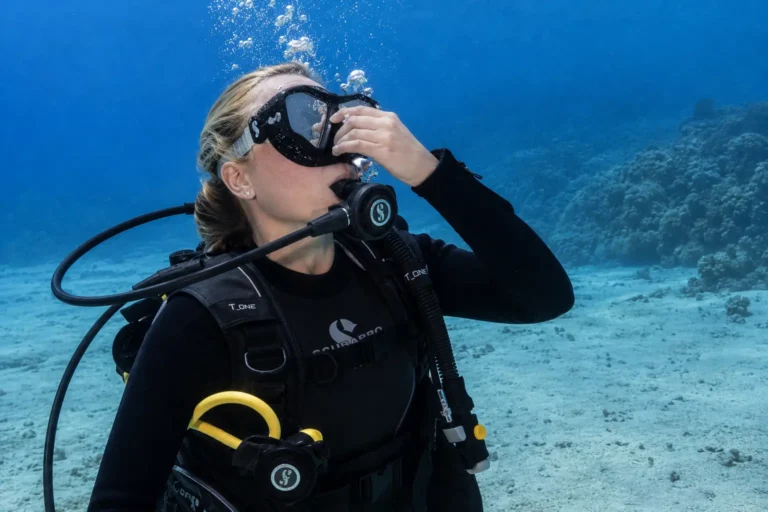
1. The Mask Partial and Full Clear
The Fear: “If water touches my nose while my eyes are open under water, I am going to inhale it and drown.”
This is the undisputed king of scuba anxiety. The moment water fills your mask, a primitive panic reflex kicks in, telling you to rush to the surface. New divers often struggle to separate breathing through their mouth (via the regulator) from breathing through their nose.
How We Help You Master It:
We don’t just drop you into deep water and ask you to flood your mask. We build up to it in tiny, manageable steps in our shallow training water.
- First, we practice putting our faces in the water without a mask, just breathing through the regulator to prove to your brain that your airway is totally sealed.
- When it comes to clearing the mask, we teach you the “Look Up and Blow” technique. You place two fingers at the very top of your mask frame, tilt your head back to look at the surface, and blow a long, steady breath exclusively out of your nose. The air naturally forces the water out the bottom of the mask.
- The Pro Fix: Keep your eyes closed if the saltwater stings! You don’t need to see to clear your mask.
2. Regulator Recovery (The Arm Sweep)
The Fear: “If my regulator gets knocked out of my mouth, I won’t be able to find it, and I’ll run out of air.”
During training, your instructor will have you deliberately spit out your regulator, let it drop behind your shoulder, and then find it again. New divers sometimes get disoriented when trying to reach behind their backs to grab the hose.
How We Help You Master It:
We teach you the “Leaning Arm Sweep.” It relies entirely on gravity and physics rather than blindly reaching around.
- When you spit out the regulator, you tilt your body slightly to the right. This causes the regulator hose to naturally swing away from your cylinder and hang lower in the water.
- You then take your right hand, touch your right thigh, sweep your arm all the way back to your tank valve, and then bring it forward in a giant arc. The hose will automatically catch on your arm every single time. It is a foolproof mechanical movement that requires zero guesswork.
3. Finding Neutral Buoyancy (The Hover)
The Fear: “I feel like a human yo-yo. I’m either crashing into the sand or rocketing toward the surface.”
Buoyancy is a delayed reaction. New divers push the inflate button on their BCD, don’t feel anything happen immediately, so they push it three more times. A few seconds later, they are floating upward like a balloon. When they deflate, they dump too much air and crash back down.
How We Help You Master It:
We teach you to breathe your way into buoyancy and respect the delay. Your lungs are your primary BCD; they hold roughly 4 to 5 liters of air capacity.
- We use the “Pivot and Breathe” drill. We have you lie flat on your stomach on a sandy patch, and using only the volume of your inhalations and exhalations, we show you how your body gently rises and falls without ever touching your BCD buttons.
- We teach you to make tiny, half-second adjustments to your BCD jacket. If you add air, wait three seconds to see where you settle before touching the button again.
4. Ear Equalization (The Squeeze)
The Fear: “My ears hurt as soon as I drop below two meters, and I’m scared I’m going to damage them.”
Equalizing your ears (the Valsalva maneuver) feels unnatural to many. New divers often wait until they feel pain before they try to clear their ears, or they pinch their nose and blow far too hard, causing frustration and discomfort.
How We Help You Master It:
The secret to successful equalization is proactivity and patience.
- We teach you to equalize early and often. You should equalize your ears on the boat deck, again the second your snorkel submerges, and then with every single breath as you descend down our training line. If you wait until it hurts, you’ve waited too long.
- The Pro Fix: If your ear gets blocked, we have you ascend one or two meters to relieve the pressure, tilt the blocked ear toward the surface to stretch the Eustachian tube, and try equalizing gently again. We never, ever force a descent.
5. The Controlled Emergency Swimming Ascent (CESA)
The Fear: “I have to swim all the way to the surface from 9 meters on a single breath of air while screaming? That’s impossible.”
The CESA simulates an out-of-air scenario where you must swim horizontally or vertically to the surface while maintaining a continuous exhalation (making a continuous “ahhhhh” sound) to prevent lung over-expansion injuries. New divers are terrified they will run out of breath halfway up.
How We Help You Master It:
First, you need to understand that your lungs are actually full of air at depth; as you ascend, that air expands, meaning your body naturally has plenty of volume to sustain the sound.
- We practice the breathing rhythm on dry land first.
- When we do it in the ocean, your instructor is looking you directly in the eyes, holding onto your BCD, and swimming right alongside you. You are completely safe. If you run out of breath or stop making the sound, the instructor stops the drill instantly and gives you your regulator back.
- The Pro Fix: Think of it like humming a short song, not a scream. A tiny, steady stream of bubbles is all it takes to keep your lungs safe.
The Sierra Madre Difference: Patience is Our Superpower
Every single world-class technical diver, divemaster, and instructor was once a beginner who struggled to clear their mask or find their trim. These hurdles are a completely normal part of the learning curve.
At Sierra Madre Divers, we operate a PADI 5-Star Dive Center with incredibly small class sizes. We don’t have a stopwatch running in the water. If a skill takes you five minutes or five hours to master, we will sit right there with you on the shallow sand until the lightbulb goes on and you realize: “Hey, I can do this!”
Don’t let a few pool skills keep you from exploring the magic of the Bohol Sea. Contact us today to sign up for your Open Water course, and let’s master these skills together at your exact pace!