Mastering the Drop: How to Improve Your Buoyancy Before Diving Bohol’s Steep Walls
There is a very specific thrill that comes with wall diving.
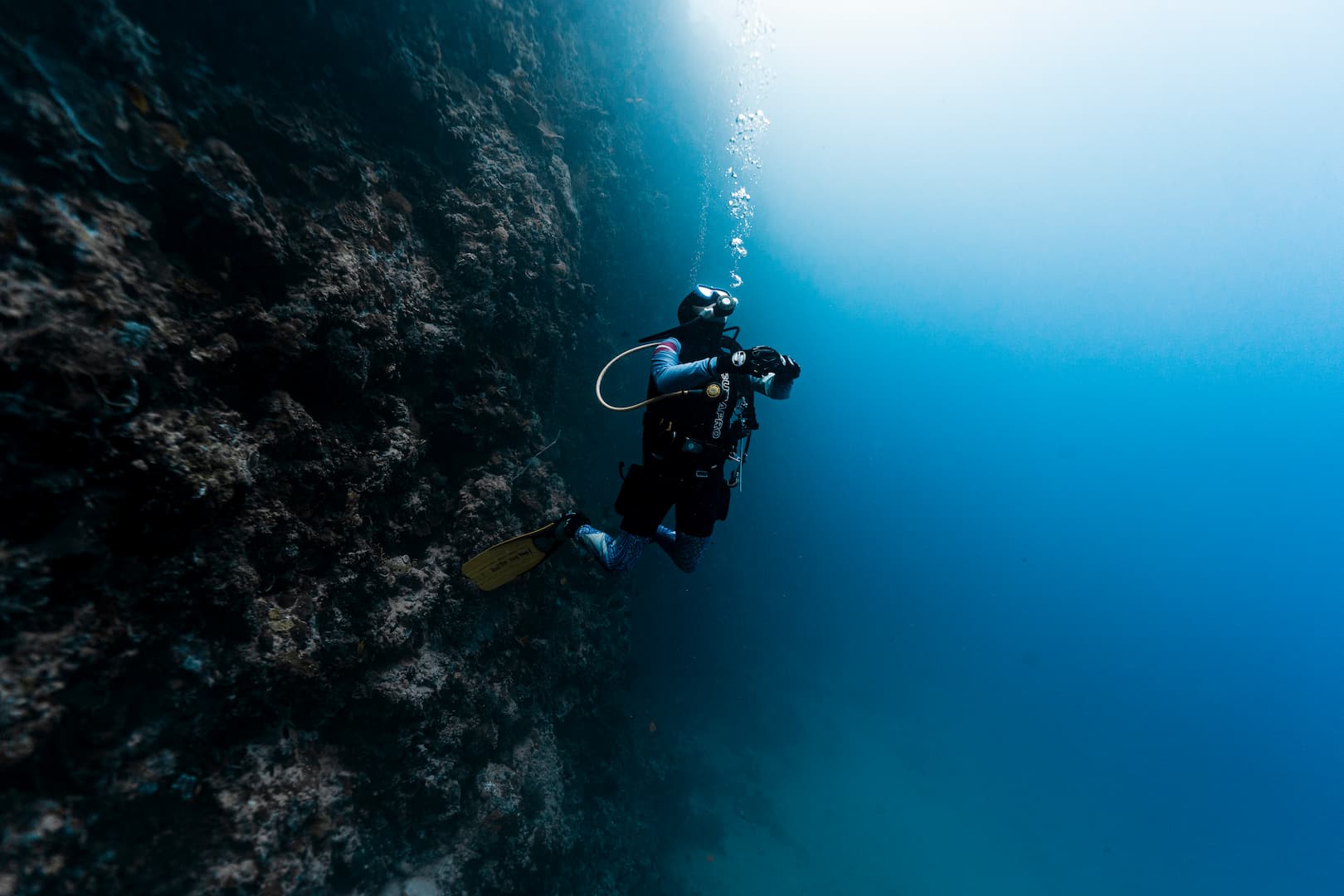
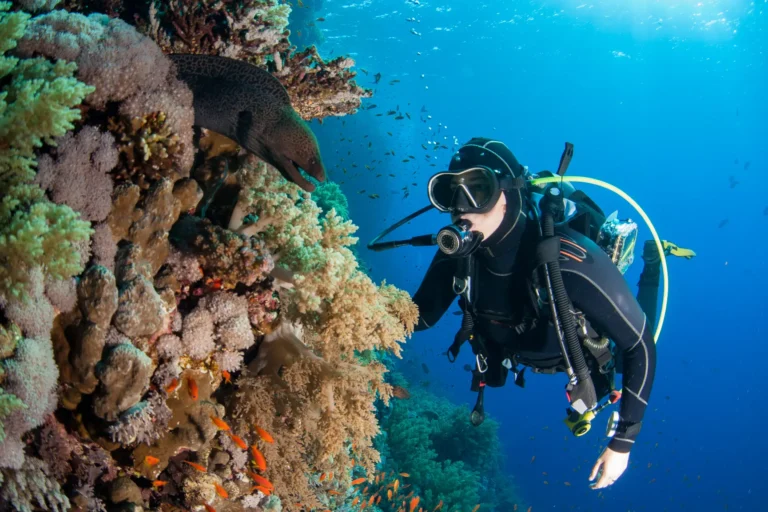
You are swimming along a sunlit, shallow coral plateau in five meters of water, surrounded by colorful anthias and grazing turtles. Then, suddenly, the reef simply vanishes. You kick past the edge, and the bottom drops away into a mesmerizing, deep blue abyss. You are no longer swimming over the earth; you are flying alongside it.
Bohol is world-renowned for this exact topography. From the vibrant drop-offs of Balicasag Island to the dramatic, deep vertical plunges of Doljo Point, wall diving is the defining feature of the Panglao diving experience.
But this exhilarating environment comes with a catch: it demands absolute control.
When you lose your buoyancy over a sandy bottom, you bump your knees. When you lose your buoyancy on a sheer wall with no bottom in sight, you can easily drop past your planned depth limit, burning through your air and risking decompression sickness. Alternatively, an uncontrolled ascent from a deep wall can be equally dangerous.
If you want to feel like a superhero flying through the water rather than a runaway elevator, here is your ultimate guide to dialing in your buoyancy before you tackle the steep walls of Bohol with Sierra Madre Divers.
The Enemy of the Wall: Overweighting
The single biggest cause of bad buoyancy on a dive is wearing too much lead.
Many divers, especially those who haven’t been in the water for a year, strap on an extra two kilos “just to be safe” and make sure they can get down. This is a massive mistake for wall diving.
When you are overweighted, you have to pump a huge amount of air into your BCD at depth just to stay neutral. Because air compresses and expands with pressure, every time you move up or down a meter along the wall, that massive bubble of air in your jacket drastically changes size. You spend the entire dive fighting a see-saw effect, constantly inflating and deflating, burning through your air supply in record time.
The Fix: The Surface Weight Check Before we ever take you to Balicasag, your Sierra Madre Divers guide will likely do a checkout dive at a local, shallow site like Alona Beach. Ask them to help you do a proper weight check.
- With an almost empty tank (around 50 bar), you should float at eye-level while holding a normal breath, with your BCD completely deflated.
- When you exhale, you should slowly sink.
- Drop the “safety kilos.” Diving with the exact right amount of weight makes maintaining a hover on a wall feel effortless.
The Lungs: Your Primary BCD
Your BCD is designed to compensate for the compression of your wetsuit at depth. It is not meant to be an elevator button. Once you are neutrally buoyant at your target depth along the wall, you should rarely need to touch your inflator hose.
Instead, use your lungs. They are your micro-adjusters.
When you are drifting along the Black Forest and you see a beautiful nudibranch slightly above you on the wall, don’t add air to your BCD. Simply take a slightly deeper, longer breath in. Your lungs will expand, your body volume will increase, and you will gently rise a meter or two. When you want to drop back down to your group, exhale slowly and fully.
The Fix: Rhythmic Breathing The key to lung buoyancy is a continuous, slow rhythm. Never hold your breath, but learn to pause slightly at the top of an inhalation to rise, and at the bottom of an exhalation to sink. Mastering this means you can navigate the small overhangs and ledges of a wall using nothing but the power of your breath.
The Art of Trim: Stop the “Seahorse” Dive
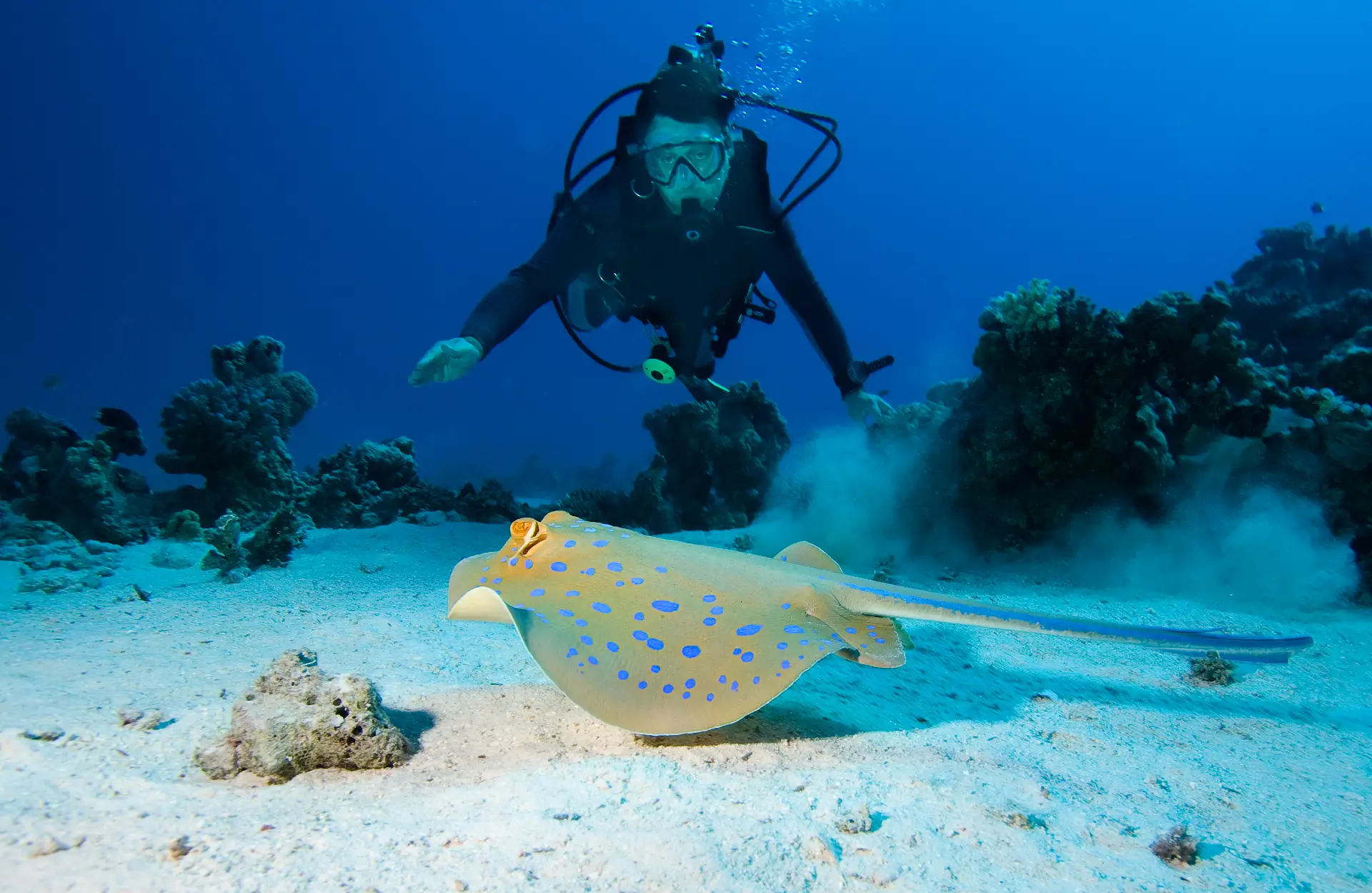
Buoyancy is only half the battle; the other half is “trim.” Trim refers to your body’s position in the water.
Many divers unknowingly dive diagonally, like a seahorse. Their head is up, and their fins are pointing down. On a wall dive, this is disastrous. Every time a “seahorse” diver kicks to move forward, their downward-pointing fins actually push them up toward the surface. To counteract this, they dump air from their BCD, making them negatively buoyant, which means they have to kick harder just to keep from sinking. It is an exhausting cycle.
Furthermore, kicking downward near a wall can easily smash the delicate corals and sponges growing on the rock face.
The Fix: Get Horizontal You want to be completely flat, parallel to the surface, like a skydiver.
- Look forward, not down.
- Arch your back slightly.
- Bend your knees at a 90-degree angle to keep your fins elevated and away from the reef.
- From this horizontal position, use the Frog Kick (as discussed in our previous guide). This directs the thrust straight back, propelling you smoothly along the wall without altering your depth or damaging the environment.
The Visual Trap: Don’t Stare into the Blue
Wall diving plays tricks on your brain. When you are swimming over a sandy bottom, you have a constant visual reference to tell you if you are sinking or rising.
On a sheer drop-off, if you turn your back to the reef to watch a passing school of barracuda out in the deep blue, you lose your visual reference. Without noticing, you can easily drop five meters or float up to the surface, because the blue water looks exactly the same at 15 meters as it does at 25 meters.
The Fix: Lock Onto the Wall Always keep a piece of the wall in your peripheral vision. Use a specific sponge, a horizontal crack, or a prominent gorgonian fan as your reference point. If that fan suddenly starts moving “up” relative to your mask, you know you are sinking. Check your dive computer frequently to confirm your depth, but let the wall be your primary guide.
Managing the Edge: The Drop-Off Technique
The trickiest part of a wall dive is the transition—swimming from the shallow 5-meter plateau over the edge into the deep.
Because the water gets deep instantly, it is very easy to just let gravity take over and plummet. This can lead to ear barotrauma if you can’t equalize fast enough, and it makes it very hard to stop yourself at your planned depth.
The Fix: Vent Before You Drop As you approach the edge of the drop-off, anticipate the descent. Hold your inflator hose up and vent a tiny burst of air before you cross the threshold. Exhale deeply and kick smoothly over the edge. As you descend, add tiny “micro-bursts” of air to your BCD to slow your fall. You want to ease into your target depth, not crash into it.
Become a Master of the Hover
Perfect buoyancy is the hallmark of an elite diver. It allows you to conserve air, protect the fragile marine sanctuaries of Bohol, and position yourself perfectly for that wide-angle photograph of the sardine run.
If you feel like your buoyancy is more “bounce” than “hover,” don’t let it ruin your trip to Balicasag. When you book your diving with Sierra Madre Divers, ask us about the PADI Peak Performance Buoyancy (PPB) specialty course.
We can spend a morning at a calm local site fine-tuning your weight, fixing your trim, and dialing in your breathing techniques. By the time we take you to the big walls, you will be flying weightless, ready to experience the true magic of the drop.