The Ocean’s Ancient Mariners: Why Bohol is the Ultimate Destination to Dive with Sea Turtles
For many scuba divers, regardless of how many hundreds of hours they have logged underwater, there is one marine encounter that never loses its magic: coming face-to-face with a sea turtle. There is something profoundly humbling about sharing the water with these ancient mariners. They glide through the ocean with an effortless, slow-motion grace that instantly lowers your heart rate and reminds you exactly why you learned to dive in the first place.
However, in many dive destinations around the world, spotting a sea turtle is a game of chance. You might spend a week diving and only catch a fleeting glimpse of a shell disappearing into the blue. It is treated as a rare, lucky bonus.
Then, there is Bohol.
If your 2026 diving bucket list includes guaranteed, high-quality, and intimate encounters with sea turtles, you can stop your research right now. Bohol, and specifically the marine sanctuaries surrounding Panglao Island, is unequivocally one of the best places in the Philippines—and arguably all of Southeast Asia—to dive with these magnificent creatures. At Sierra Madre Divers, we don’t just hope to see turtles; they are an integral, daily part of our underwater office.
Here is an in-depth look at why Bohol is a world-class turtle hotspot, the specific species you will encounter, and how to interact with them responsibly.
The Stars of the Show: Which Turtles Will You See?
The waters of the Bohol Sea are home to a rich variety of marine life, but when it comes to turtles, there are two primary species that dominate our reefs. Knowing how to tell them apart adds a fascinating layer of marine biology to your dives.
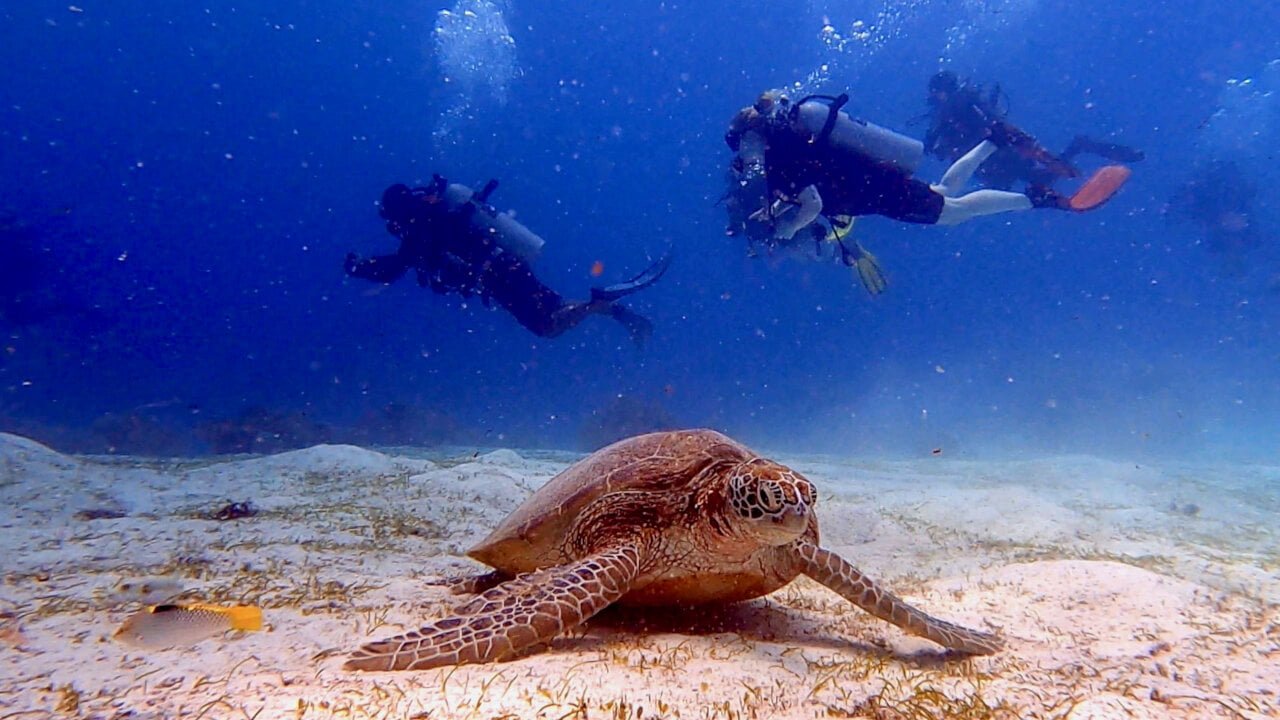
1. The Green Sea Turtle (Chelonia mydas)
These are the gentle giants of Bohol. Despite their name, their shells are usually a beautiful mix of brown, olive, and black. They get the name “Green” from the color of their body fat, which is tinted by their strictly herbivorous diet. Adult Green Sea Turtles are massive, often reaching up to 1.5 meters (5 feet) in length and weighing over 150 kilograms. They have a smooth, dome-shaped shell and a relatively blunt, rounded snout.
Because they feed primarily on seagrass and algae, you will often find them in the shallow, sunlit plateaus of our dive sites, happily grazing like underwater cows, completely unbothered by the presence of respectful divers.

2. The Hawksbill Turtle (Eretmochelys imbricata)
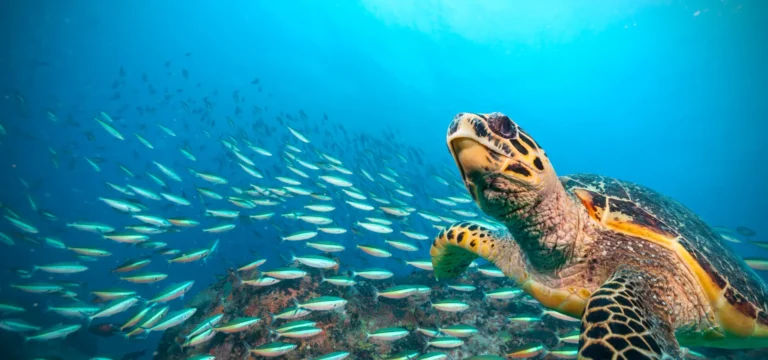
The Hawksbill is smaller, more agile, and visually striking. They are named for their sharp, curving beak (much like a hawk’s), which is perfectly evolved for their highly specialized diet. Unlike the vegetarian Green Turtles, Hawksbills are carnivores that feed almost exclusively on sea sponges. They use their pointed beaks to reach into the deep crevices of the coral reef to extract their toxic meals.
Hawksbills have a stunning, mottled shell with overlapping scutes (scales) and serrated edges. Tragically, this beautiful shell made them a massive target for the illegal “tortoiseshell” trade for decades. Today, seeing these critically endangered turtles thriving in Bohol’s protected waters is a massive conservation victory.
Balicasag Island: The Turtle Mecca of the Visayas
If you want to understand why Bohol is famous for turtles, you only need to look at one specific location: the Balicasag Island Marine Sanctuary. Just a short boat ride from the Sierra Madre Divers shop on Alona Beach, this small, circular island is the undisputed epicenter of turtle activity.
Balicasag offers the perfect combination of geography and strict environmental protection. The island is surrounded by a shallow shelf (ranging from 5 to 10 meters deep) that is carpeted in lush seagrass beds and rich coral gardens. This is the ultimate dining room for the turtles. Just a few fin kicks away, this shallow shelf plunges into spectacular, near-vertical walls that drop to 50 meters and beyond. These walls provide deep ledges, overhangs, and small caves.
This topography means that on sites like Rico’s Wall and the Black Forest, you get to witness the full spectrum of turtle behavior. At the start of your dive on the shallow plateau, you will glide over Green Sea Turtles munching on the grass. As you drift over the drop-off to explore the wall, you will find Hawksbills using their beaks to rip sponges from the rock, or massive adults wedged into crevices, taking a mid-day nap.
The sheer density of the population here is staggering. It is not uncommon for our groups to lose count after spotting 10 or 15 individual turtles on a single dive. Because Balicasag has been a strict, no-take Marine Protected Area for years, the turtles here are remarkably docile. They do not view divers as a threat, allowing for prolonged, peaceful observation.
Beyond Balicasag: The Wild Encounters of Pamilacan Island
While Balicasag is the guaranteed “aquarium” experience, it is not the only place our shelled friends reside. For divers looking for a slightly more rugged and wild experience, Pamilacan Island offers a thrilling alternative.
At dive sites like the Spanish Tower, the underwater landscape is craggier and the currents are often stronger. Here, you are more likely to encounter Hawksbill turtles expertly navigating the sweeping flow, tucking themselves into the deep cuts of the wall to rest or hunt for sponges. The encounters at Pamilacan often feel a bit more raw and solitary. When you spot a turtle here, it is usually just you, your Sierra Madre dive guide, and the animal, sharing a quiet moment in the vast blue of the Bohol Sea.
The Rules of Engagement: Turtle Etiquette
Having the privilege of diving in one of the world’s best turtle habitats comes with a profound responsibility. At Sierra Madre Divers, the safety and well-being of the marine life are our absolute highest priorities. When you dive with us, we enforce strict “Turtle Etiquette” to ensure these animals remain wild, safe, and unstressed.
- Never Touch or Chase: This is the golden rule. Turtles are wild animals. Touching them can remove the protective mucus layer on their shells and skin, exposing them to dangerous infections. Chasing a turtle will cause it to panic, burn vital energy, and flee the sanctuary.
- Do Not Block Their Path to the Surface: Sea turtles are reptiles; they must breathe air. They can hold their breath for hours while sleeping, but when they are active, they need to surface frequently. Never hover directly above a turtle. Always ensure they have a clear, unobstructed path to the sky.
- Master Your Buoyancy: This is where your skills as a diver matter most. When divers get excited about seeing a turtle, they often forget their surroundings and crash down onto the fragile coral reef. Maintain excellent buoyancy, stay off the bottom, and observe from a respectful distance.
- The Passive Approach: The best encounters happen when you do nothing at all. If you spot a turtle, stop swimming. Hover neutrally buoyant and simply watch. Often, their natural curiosity will lead them to swim right past you.
Experience the Magic with Sierra Madre Divers
There is a massive difference between just seeing a turtle and truly experiencing the encounter. Because Sierra Madre Divers is a PADI 5-Star Dive Center, we prioritize small groups and personalized guiding. You will never be dumped onto a reef with twenty other divers, fighting for a glimpse of a shell.
Our expert local guides know the reefs of Balicasag and Pamilacan intimately. We know the specific ledges where the old giants sleep, and we know how to navigate the currents so you can drift effortlessly alongside them. We handle the logistics, the navigation, and the safety, leaving you free to focus entirely on the magic of the moment.
If you are ready to log the best turtle dives of your life in 2026, the Bohol Sea is calling. Contact Sierra Madre Divers today to book your adventure, and let us introduce you to the ancient mariners of the Philippines.