The Polka-Dot Jewel of the Reef: Discovering the Yellowspotted Wrasse in the Bohol Sea
When divers first arrive in Bohol, their wish lists are usually dominated by the giants. They want the massive Green Sea Turtles of Balicasag Island, the swirling tornadoes of Jackfish, and the plunging, bottomless walls of Doljo Point.
But as any seasoned diver will tell you, if you spend your entire dive staring out into the deep blue looking for the “big stuff,” you are going to miss the intricate, vibrant, and wildly entertaining metropolis functioning right beneath your fins. The reefs of Panglao and its surrounding islands are world-class macro destinations. And among the corals, darting like a caffeinated gemstone, is one of our favorite small wonders: the Yellowspotted Wrasse.
Scientifically known as Anampses meleagrides, this small but spectacular fish is a burst of color and energy that brings the shallow coral gardens of the Bohol Sea to life.
Whether you are a macro photographer looking for a challenge or a casual diver who loves vibrant reef fish, the Yellowspotted Wrasse is a creature that demands your attention. Here is a deep dive into the fascinating biology, bizarre sleeping habits, and high-speed lifestyle of Bohol’s polka-dot jewel.
A Masterpiece of Marine Design
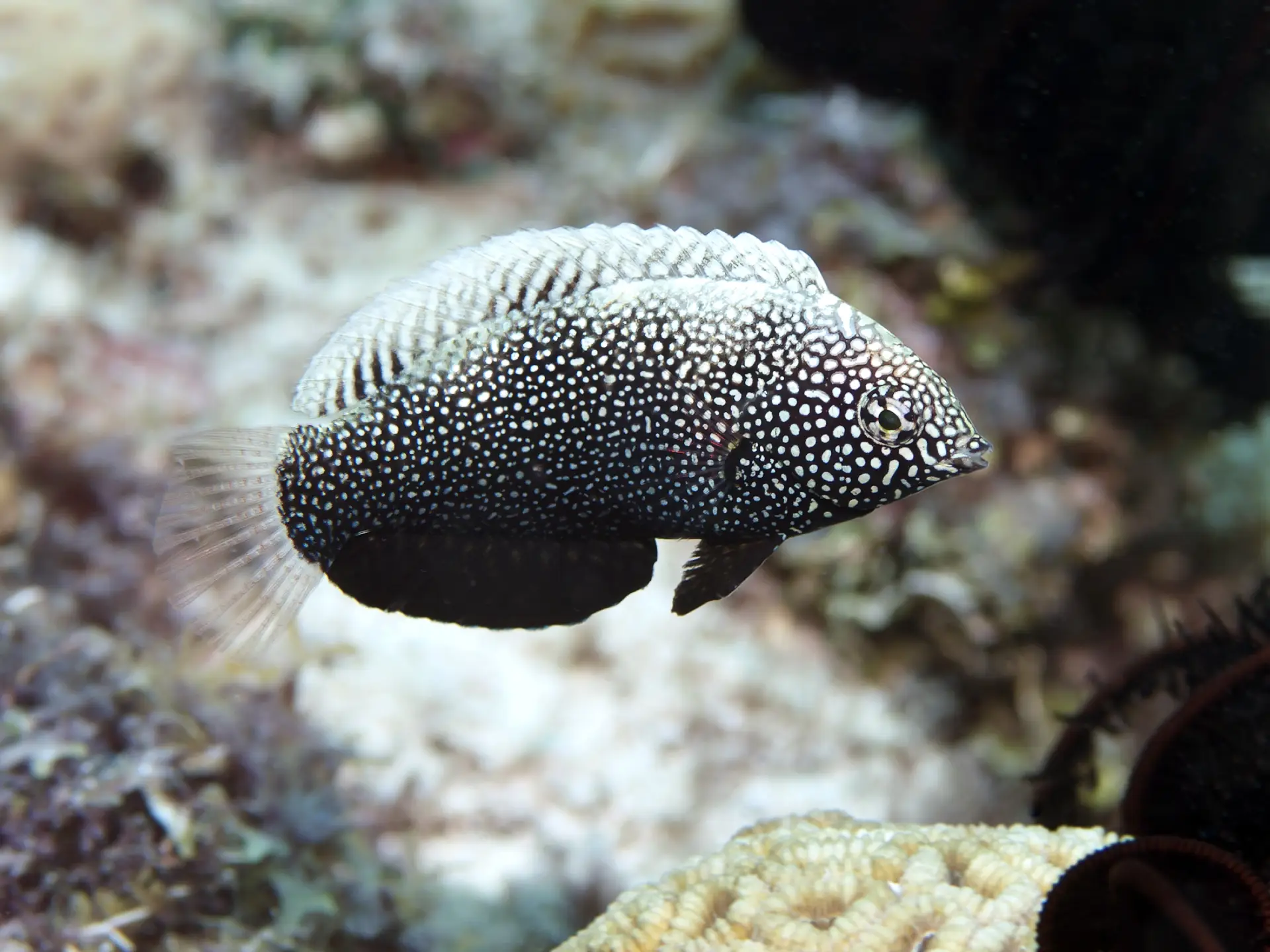
If you were to hand a toddler a black piece of paper and a bright yellow marker and tell them to design a fish, they would probably draw a Yellowspotted Wrasse.
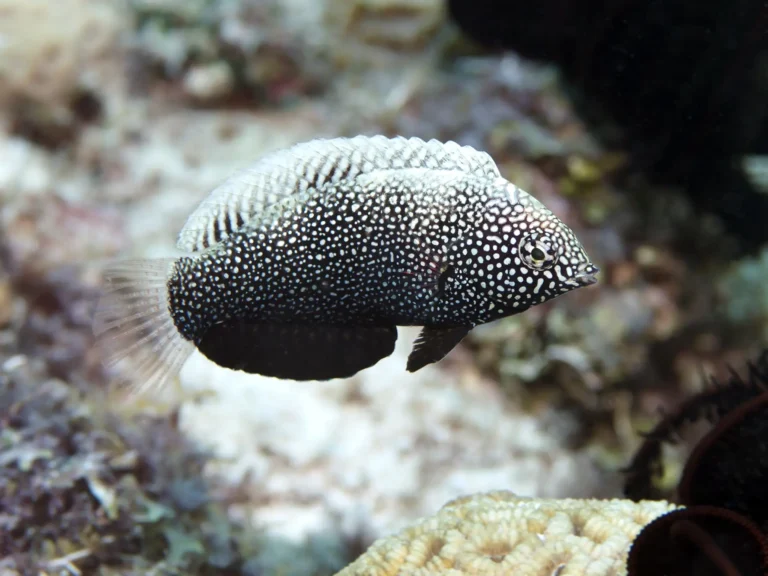
They are visually unmistakable. In their most commonly seen phase (the female phase), they possess a deep, velvety black or dark brown body that is entirely covered in brilliant, perfectly round yellow and white polka dots. To complete the ensemble, they sport a bright, neon-yellow tail that flashes like a beacon as they dart through the water.
They are relatively small, usually growing to a maximum of about 20 to 22 centimeters (8 to 9 inches). However, what they lack in size, they make up for in sheer visual impact. Against the backdrop of a blue ocean and earthy-toned hard corals, a Yellowspotted Wrasse looks like a glowing constellation swimming across the reef.
The Ultimate Shape-Shifters: A Life of Two Genders
Like many species of wrasse, the Yellowspotted Wrasse possesses a biological superpower that sounds like science fiction: they are protogynous hermaphrodites.
This means that every single Yellowspotted Wrasse is born female. They live in small harems, usually consisting of several females dominated by a single, larger male.
However, if the dominant male dies, gets eaten by a predator, or simply disappears, a profound transformation occurs. The largest, most dominant female in the group will begin to undergo a complete biological sex change. Within a matter of weeks, she will transition into a fully functional male to take over the harem.
But the transformation isn’t just internal; it is a massive visual overhaul. The new male loses the distinct black-and-yellow polka-dot pattern. Instead, his body turns a darker, purplish-brown, and the neat yellow spots stretch out into intricate, glowing blue and yellow lines. The bright yellow tail fades into a darker, patterned fin. It is such a dramatic change that, for many years, early marine biologists thought the males and females were two entirely different species of fish!
The Sand-Bed Sleepers: The Wrasse’s Nightly Vanishing Act
If you read our recent post about night diving in Bohol, you might be wondering why we didn’t mention the Yellowspotted Wrasse among the nocturnal creatures. The answer is simple: they are strictly diurnal (active during the day), and their bedtime routine is fascinating.
The Yellowspotted Wrasse does not simply tuck itself under a rock ledge or float in a cave to sleep like a parrotfish or a snapper. Instead, they require a blanket.
As the sun begins to set over Alona Beach, the wrasse seeks out a patch of fine, loose sand on the ocean floor. With a sudden burst of speed, the fish will literally dive headfirst into the sand, wriggling its body vigorously until it is completely buried beneath the surface. It will stay hidden there all night, safely concealed from prowling moray eels and hunting octopuses, before bursting back out of the sand at sunrise to start its day.
This is why, when you are diving with Sierra Madre Divers, you will only spot these beauties dancing in the sunlight, and never under the beam of your dive torch at night.
High-Speed Foragers: The Endless Energy of the Wrasse
If you stop to watch a Yellowspotted Wrasse for a few minutes, you will quickly realize they are the hyperactive toddlers of the reef. They never, ever stop moving.
They swim using a distinct “rowing” motion with their pectoral fins (the fins on their sides), which gives them a slightly bouncy, erratic swimming pattern. They spend their entire day meticulously inspecting the reef, darting into crevices, and hovering over coral heads.
They are on a constant, never-ending hunt for food. Their diet consists primarily of small benthic invertebrates—tiny crustaceans, worms, and mollusks that hide in the algae and coral rubble. They have specialized, protruding front teeth designed specifically for plucking these tiny morsels out of hard-to-reach cracks. Watching them hunt is a lesson in precision and relentless energy.
Where to Find Them in Bohol
Because the Yellowspotted Wrasse relies on specific environments—coral-rich areas for feeding and sandy patches for sleeping—the dive sites around Panglao are an absolute paradise for them.
When you dive with us, here is where you should keep your eyes peeled:
- The Shallows of Balicasag Island: Before you drop over the deep walls of the Black Forest or Rico’s Wall, take a moment to observe the shallow plateaus (at around 5 to 8 meters). The mix of hard corals and sandy channels here is prime wrasse real estate.
- Arco Point (The Hole in the Wall): The rubble zones and sloping reefs leading up to the famous tunnel are excellent places to spot both the polka-dotted females and the vividly lined terminal males.
- Alona Beach House Reefs: You don’t always need a long boat ride to find them. The local, protected reefs right off the beaches of Panglao offer the perfect combination of sandy slopes and coral blocks that these fish call home.
The Photographer’s Challenge: Capturing the Jewel
If you are an underwater photographer, the Yellowspotted Wrasse is going to test your patience and your camera settings.
Because they are constantly moving, darting, and changing direction, getting a sharp, well-composed macro shot of a wrasse is a badge of honor.
- High Shutter Speed: You will need a fast shutter speed to freeze their erratic motion.
- Pre-Focus and Wait: Chasing them is useless; they are faster than you. Instead, observe their pattern. They often circle the same coral head looking for food. Find a good composition, pre-focus your camera on a spot you expect them to pass, and wait for them to swim into your frame.
- Respect the Sand: Remember that they need the sand to sleep. Never disturb the sandy bottom unnecessarily, and maintain excellent buoyancy to avoid kicking up silt that could ruin the reef’s health (and your photo’s visibility).
Dive Into the Details
The ocean is built on layers. For every giant sea turtle or massive school of jacks, there are ten thousand tiny, colorful, bizarre creatures holding the ecosystem together. The Yellowspotted Wrasse is a perfect reminder that sometimes, the most beautiful things on the reef require you to slow down, look closer, and appreciate the small stuff.
Ready to go macro hunting? Join the expert eagle-eyed guides at Sierra Madre Divers for your next trip to Bohol. We know exactly where the jewels of the reef are hiding, and we can’t wait to show them to you.